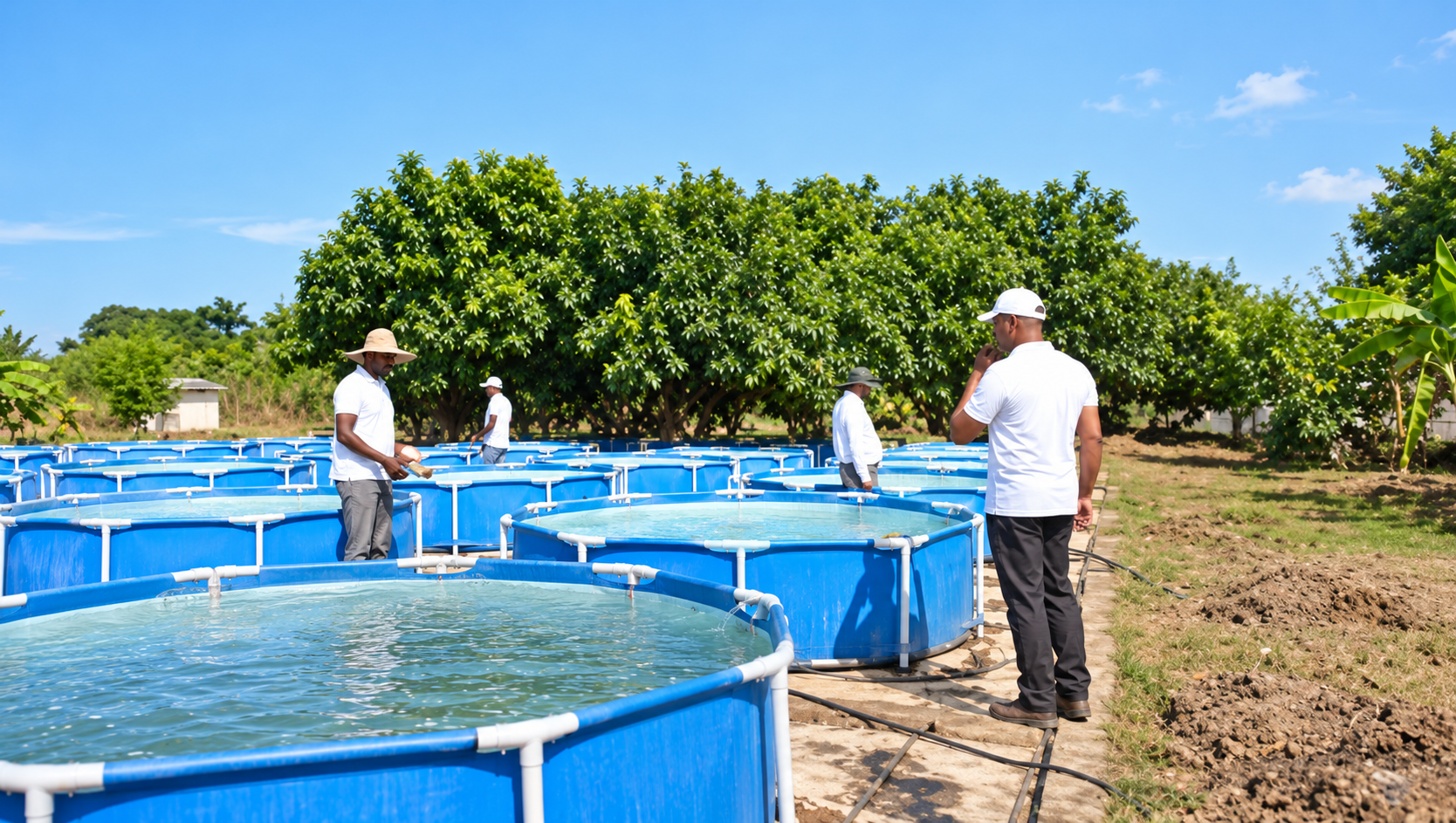
From Jos, Nigeria, to Dubai and eventually Ghana, Fredrick Kpamber’s journey has been anything but straight. Today, Kpamber, who trained in aeronautical engineering, is drawing on his unconventional experiences to make sustainable food production more practical as co-founder of Bio Green Agro, a research and development enterprise pioneering eco-aquaponics with his Ghanaian colleague, Kingsley Safo.
Building luxury aquariums in Dubai might seem a world away from growing food in Ghana. But for Fredrick Kpamber, few things are more fulfilling than seeing the skills he acquired along an unconventional journey now being put to work to improve farmers’ lives and food quality.
In Dubai, he built carefully engineered aquatic environments where water had to circulate and aquatic life had to thrive. Today, he is applying that knowledge to a different challenge: helping farmers produce food within a richer, more regenerative ecosystem while reducing their dependence on costly agricultural inputs.
It is an unlikely turn for someone whose journey began in Jos, Nigeria. Born to a Tiv father and a Berom mother, Kpamber studied in Jos before pursuing a career in aeronautical engineering. His path would eventually take him across countries and industries, through hurdles that helped shape the work he does in the food system space.
A discovery that sparked a new direction
It was a discovery in Ghana that gave his journey a new sense of purpose. Kpamber was disturbed to learn that Ghana was importing tilapia from China. For him, the situation seemed difficult to reconcile. Tilapia are native to Africa, yet an African country with its own vast aquatic resources was looking thousands of kilometres away for part of its supply of the fish. The irony frustrated him. Why should a continent where tilapia naturally occur depend on imports to help feed its people?
Rather than remain frustrated, Kpamber began looking for ways to put his engineering knowledge and aquatic experience to work. His experience building aquatic systems had equipped him with an understanding of aquatic ecosystems and the conditions needed to sustain fish and other species in water. He began exploring how that knowledge could support a different approach to fish production.
That frustration became one of the driving forces behind his work in eco-aquaponics. Together with his Ghanaian colleague, Kingsley Safo, he founded Bio Green Agro R&D, championing an approach that combines specialized algae cultivation with fish farming in nutrient-rich water to support crop production. Their solar-powered systems also draw on Kpamber’s engineering expertise to explore highly efficient ways of circulating water and producing agricultural inputs in an economically and ecologically viable way.
Building a more accessible food system
But beyond the machinery lies a more personal ambition: giving farmers greater control over how they produce food.
When Bio Green Agro began deploying algae-based agricultural inputs around 2020, farmers had to return each time they needed a fresh supply. For someone hoping to reach more growers, this recurring dependence presented a challenge. He began exploring portable systems that could enable farmers to produce their own inputs closer to their fields.
His goal, as he explained during the interview, is to liberate farmers through accessible technology that enables them to grow healthier food at lower cost and with greater ease.
For Joyce Mensah, a Ghanaian farmer who has used the algae bio-fertiliser, the promise of this approach is reflected in her own experience. In a 2021 Deutsche Welle report, she described improvements in her mango harvest and fruit quality after adopting the product. Her experience offers a glimpse of what such innovations could mean for farmers seeking better yields and greater confidence in producing the food we eat.
Making innovation more affordable
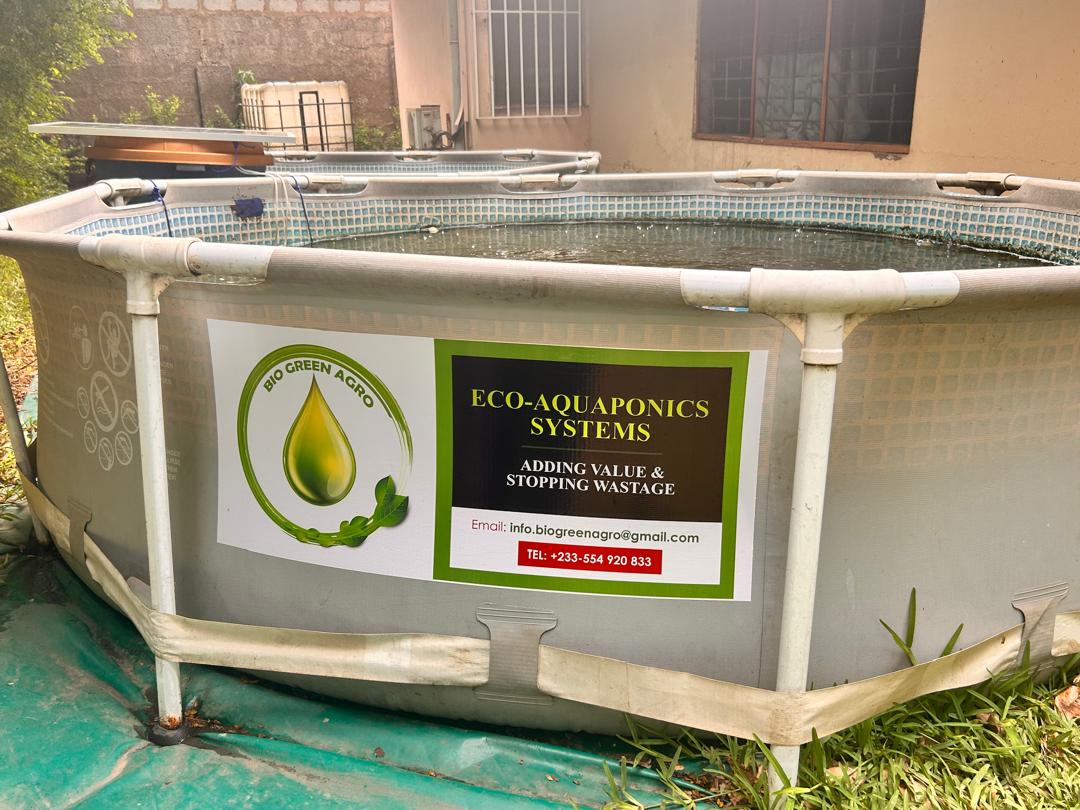
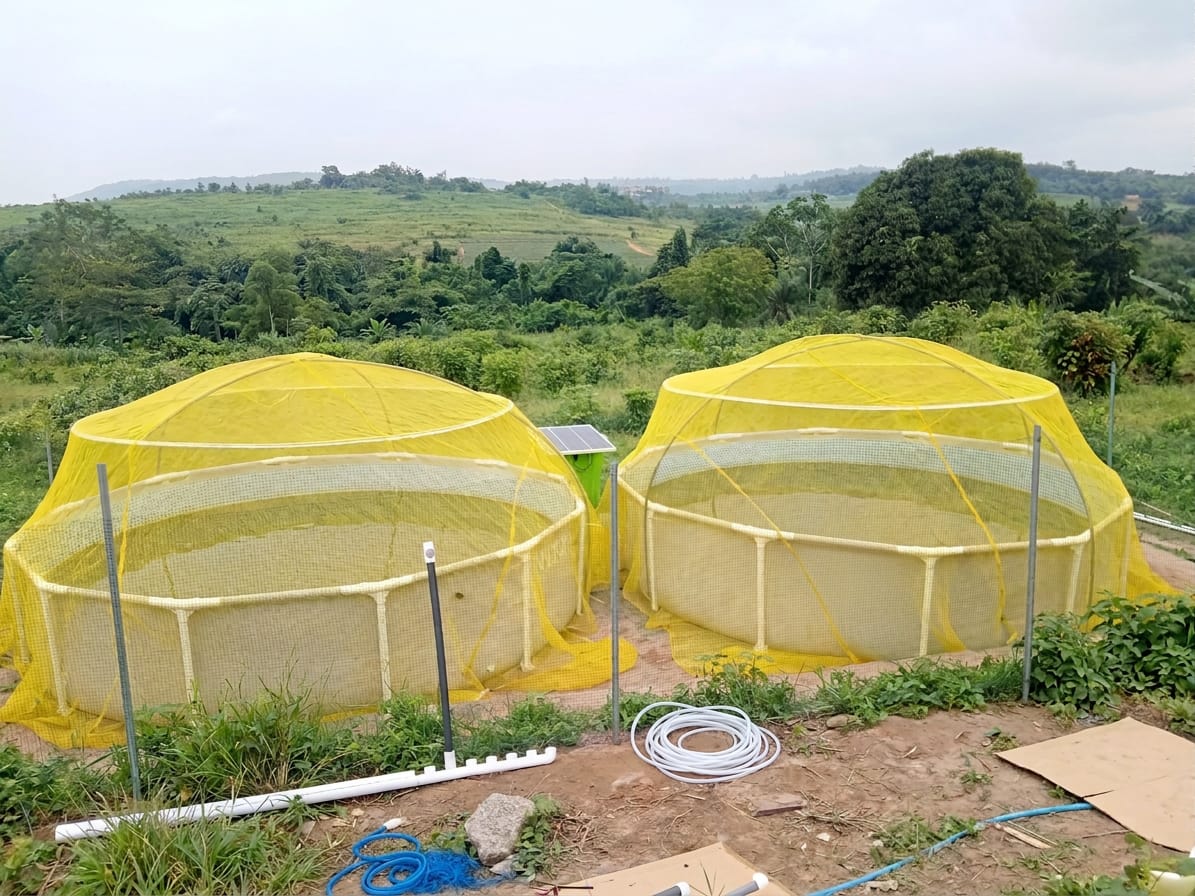
Affordability is central to Kpamber’s ambition. Bio Green Agro offers a 4,000-litre solar-powered eco-aquaponics module for $1,500, designed to grow up to 300 catfish while producing algae-rich water. The water remains fresh and odourless and is intended to support crop cultivation across 15 acres.
By comparison, an industrial automated algae photobioreactor advertised online is listed at $500,000. Although the two systems differ significantly in scale and function, the price contrast illustrates Kpamber’s approach to innovation: developing technology that is potentially within reach of agricultural producers rather than exclusively large industrial operators. At $1,500, his system still represents a substantial investment for many smallholder farmers, but it offers a more affordable entry point into algae-based production.
His interest in algae also extends beyond crop nutrition. In Ghana, where gold mining has affected some agricultural waterways, Kpamber has explored the potential of algae to help treat contaminated water. This reflects his wider interest in using biological systems to address agricultural and environmental challenges.
Nourishing tomorrow
This year’s World Food Day theme, “Innovate today. Nourish tomorrow,” finds powerful expression in Kpamber’s journey. His transition from aeronautical engineering to luxury aquariums and now agriculture demonstrates that solutions to food-system challenges do not always originate on farms.
Yet the true value of his innovation will be measured not by the sophistication of the technology, but by the possibilities it nourishes: the inputs farmers can afford, the fish they can raise, the crops they can harvest and the healthy food they can bring to market.